
Communication in Emergency Departments: Challenges and Strategies for the Care of an Older Adult
Communication in Emergency Departments
DOI:
https://doi.org/10.24950/rspmi.2753Keywords:
Aged, Communication, Emergency Service, Hospital, Patient Care Team, Patient-Centered CareAbstract
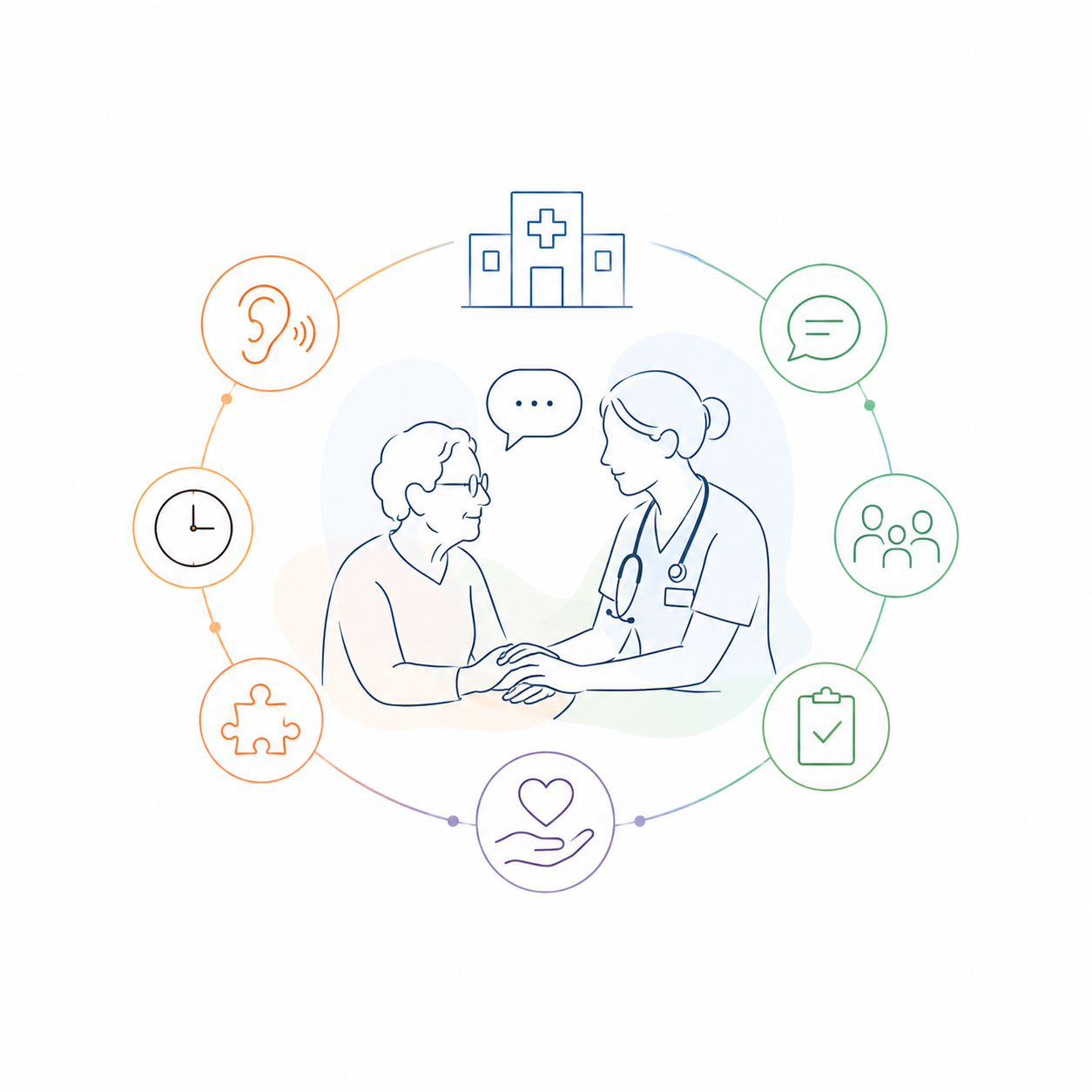
Effective communication is essential to delivering high-quality care to older adults, particularly in the complex and fast-paced environment of the Emergency Department (ED). Older patients often face unique challenges—such as sensory impairments, cognitive decline, polypharmacy, and emotional distress—that can hinder clear communication and compromise care. This paper explores key topics related to communication with older adults in the ED, including common barriers, frequent errors, and evidence-based strategies for improvement.
Barriers to effective communication may include environmental noise, time constraints, and fragmented care between multiple professionals. Common communication errors—such as using medical jargon, assuming cognitive deficits, or rushing interactions—can undermine patient autonomy, reduce comprehension, and negatively affect outcomes. In contrast, strategies such as active listening, using plain language, confirming understanding, and involving family or caregivers when appropriate, can significantly enhance communication efficacy. Special attention is also given to the sensitive task of delivering bad news, where empathy, clarity, and respect for the older patient's values are paramount.
Improving communication in the ED is not merely a best practice—it is a clinical necessity. By adopting targeted communication strategies and using appropriate tools, healthcare professionals can ensure safer, more dignified, and more patient-centred care. Furthermore, lessons learned in communicating effectively with older adults can be applied broadly to enhance interactions with patients across all age groups and care settings.
Downloads
References
1. The Lancet Healthy Longevity. Care for ageing populations globally. Lancet Healthy Longev. 2021;2. doi:10.1016/S2666-7568(21)00064-7
2. Hogan TM, Malsch A. Communication Strategies for Better Care of Older Individuals in the Emergency Department. Clin Geriatr Med. 2018;34:387-97 . doi:10.1016/j.cger.2018.04.004
3. Carpenter CR, Leggett J, Bellolio F, Betz M, Carnahan RM, Carr D, et al. Emergency Department Communication in Persons Living With Dementia and Care Partners: A Scoping Review. J Am Med Dir Assoc. 2022;23:1313.e15-13.e46. doi: 10.1016/j.jamda.2022.02.024.
4. Alves M, Távora C, Silva JF, Gomez N, Fonseca T. To how much noise are we exposing hospitalized elderly patients during sleep? Acta Med Port. 2021;34711-2. doi:10.20344/amp.16353
5. Alves M, Marques Macedo I, Gomez N, Távora C, Sarmento F, Marques Macedo I, et al. Night-Time Noise and Sleep Quality in an Internal Medicine Ward in Portugal: An Observational Study. Acta Med Port. 2024;37:119-25. doi:10.20344/amp.19042
6. Ejjebli S. Unlocking the Power of Language: Navigating Linguistic Diversity in Cross-Cultural Research. Stud Pragmatics Discourse Analys. 2024;5. doi:10.48185/spda.v5i1.1020
7. Costa A, Feteira-Santos R, Alarcão V, Henriques A, Madeira T, Virgolino A, et al. Health Literacy among Older Adults in Portugal and Associated Sociodemographic, Health and Healthcare-Related Factors. Int J Environ Res Public Health. 2023;20:4172. doi: 10.3390/ijerph20054172.
8. Gaffney HJ, Hamiduzzaman M. Factors that influence older patients’ participation in clinical communication within developed country hospitals and GP clinics: A systematic review of current literature. PLoS One. 2022;17:e0269840. doi:10.1371/journal.pone.0269840
9. Howick J, Bennett-Weston A, Solomon J, Nockels K, Bostock J, Keshtkar L. How does communication affect patient safety? Protocol for a systematic review and logic model. BMJ Open. 2024;14:e085312. doi:10.1136/BMJOPEN-2024-085312
10. Mejia AM, Smith GE, Wicklund M, Armstrong MJ. Shared decision making in mild cognitive impairment. Neurol Clin Pract. 2019;9:160. doi:10.1212/CPJ.0000000000000576
11. Dixon J. Social Determinants of Health by Michael Marmot and Richard Wilkinson - Book Review. Health Promot Int. 2000;15:87-9.
12. Jack K, Ridley C, Turner S. Effective communication with older people. Nurs Older People. 2019;31:40-8. doi:10.7748/NOP.2019.E1126
13. Egelhofer M. Health Communication: From Theory to Practice. Biotechnol J. 2007;2. doi:10.1002/biot.200790098
14. Reed NS, Assi L, Pedersen E, Alshabasy Y, Deemer A, Deal JA, et al. Accompaniment to healthcare visits: the impact of sensory impairment. BMC Health Serv Res. 2020;20:990. doi:10.1186/S12913-020-05829-8
15. Levin E, Aburub H. Barriers and Solutions to Comprehensive Care for Mental Health Patients in Hospital Emergency Departments. J Ment Health Clin Psychol. 2024;8:26-34.
16. Mwakilasa MT, Foley C, O’Carroll T, Flynn R, Rohde D. Care Experiences of Older People in the Emergency Department: A Concurrent Mixed-Methods Study. J Patient Exp. 2021;8. doi:10.1177/23743735211065267,
17. Whitson HE, Cronin-Golomb A, Cruickshanks KJ, Gilmore GC, Owsley C, Peelle JE, et al. American Geriatrics Society and National Institute on Aging Bench-to-Bedside Conference: Sensory Impairment and Cognitive Decline in Older Adults. J Am Geriatr Soc. 2018;66:2052. doi:10.1111/JGS.15506
18. Baile WF, Buckman R, Lenzi R, Glober G, Beale EA, Kudelka AP. SPIKES—A Six-Step Protocol for Delivering Bad News: Application to the Patient with Cancer. Oncologist. 2000;5:302-11. doi:10.1634/THEONCOLOGIST.5-4-302,
19. Antonelli-Incalzi R, Marra C. The screening of cognitive impairment in the emergency department: A valuable clinical and epidemiological goal. Eur J Intern Med. 2024;130:62-4. doi:10.1016/J.EJIM.2024.10.003
20. Fry M, Elliott R, Murphy S, Curtis K. The role and contribution of family carers accompanying community-living older people with cognitive impairment to the emergency department: An interview study. J Clin Nurs. 2022;31:975-84. doi:10.1111/JOCN.15954,
Downloads
Published
How to Cite
Issue
Section
Categories
License
Copyright (c) 2026 Portuguese Journal Internal Medicine

This work is licensed under a Creative Commons Attribution 4.0 International License.