
Inteligência Artificial: Desafios para a Investigação, os Resultados Científicos e a Publicação Académica
DOI:
https://doi.org/10.24950/rspmi.2880Palavras-chave:
Comunicação Científica, Ética na Investigação, Inteligência Artificial, Inteligência Artificial Generativa, Má Conduta Científica, PublicaçãoResumo
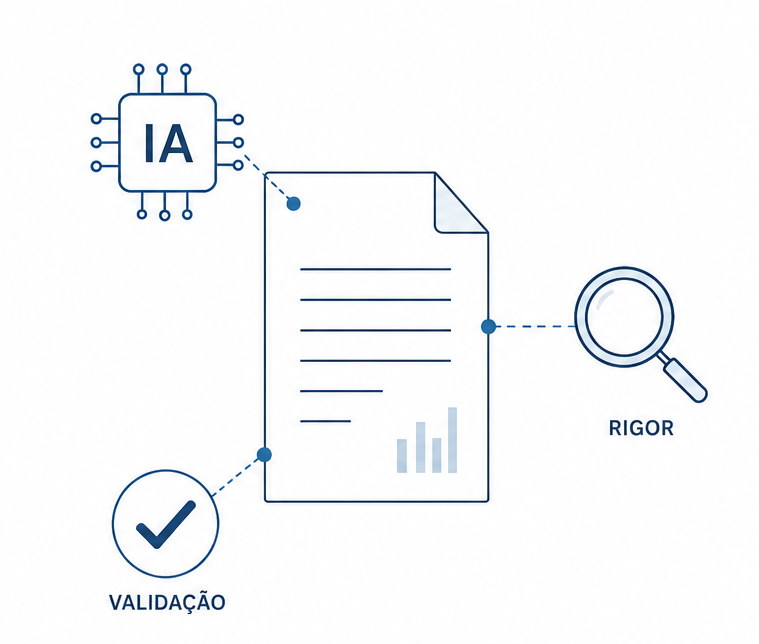
A Inteligência Artificial (IA) tornou-se, em poucos anos, uma das forças mais transformadoras da ciência contemporânea. O seu impacto ultrapassa largamente o domínio tecnológico e estende-se à forma como investigamos, escrevemos, validamos resultados, comunicamos conhecimento e avaliamos a produção científica. A questão central desta reflexão é como integrar a IA na investigação e na publicação científica sem comprometer valores fundamentais como a verdade, o rigor, a transparência, a responsabilidade e a equidade.
Downloads
Referências
1. Stokel-Walker C, Van Noorden R. What ChatGPT and generative AI mean for science. Nature. 2023;614:214-6. doi: 10.1038/d41586-023-00340-6.
2. Russell S, Norvig P. Artificial Intelligence: A Modern Approach. 4.ª ed. Yorkshire: Pearson; 2021.
3. Goodfellow I, Bengio Y, Courville A. Deep Learning. Massachusetts:MIT Press;2016.
4. Bender EM, Gebru T, McMillan-Major A, Shmitchell S. On the dangers of stochastic parrots: Can language models be too big? In: Proceedings of the 2021 ACM Conference on Fairness, Accountability, and Transparency. p. 610–23.
5. Hochreiter S, Schmidhuber J. Long short-term memory. Neural Computation. 1997;9:1735–80.
6. Gers FA, Schmidhuber J, Cummins F. Learning to forget: Continual prediction with LSTM. Neural Computation. 2000;12:2451–71.
7. Vaswani A, Shazeer N, Parmar N, Uszkoreit J, Jones L, Gomez AN, et al. Attention is all you need. Adv Neural Informat Process Syst. 2017; 30:5998–6008.
8. Brown TB, Mann B, Ryder N, Subbiah M, Kaplan J, Dhariwal P, et al. Language models are few-shot learners. Adv Neural Informat Process Syst. 2020;33:1877–901.
9. Andrade F, Novais P, Machado J, Neves J. Contracting agents: Legal personality and representation. Artif Intell Law. 2007;15.
10. Bourtoule L, Chandrasekaran V, Choquette-Choo CA, Jia H, Travers A, Zhang B, et al. Machine unlearning. In: 2021 IEEE Symposium on Security and Privacy (SP). P. 141–59.
11. Machado J, Sousa R, Peixoto H, Abelha A. Ethical Decision-Making in Artificial Intelligence: A Logic Programming Approach. AI. 2024; 5:2707-24. doi: 10.3390/ai5040130
12. Tools such as ChatGPT threaten transparent science; here are our ground rules for their use. Nature. 2023;613:612. doi: 10.1038/d41586-023-00191-1.
13. Parlamento Europeu & Conselho da União Europeia. Regulamento (UE) 2024/1689 do Parlamento Europeu e do Conselho, de 13 de junho de 2024, que estabelece regras harmonizadas em matéria de inteligência artificial (Regulamento da Inteligência Artificial). J Ofic União Europeia: 2024; L1689.
14. Doshi-Velez F, Kim B. Towards a rigorous science of interpretable machine learning. arXiv preprint arXiv, 2017:1702.08608.
15. Gala A, Marcondes F, Rodrigues M, Machado J, Novais P. Semiotic ablation as an interface-level XAI method for analyzing generative uncertainty in large language models. In: Proceedings of the 4th World Conference on eXplainable Artificial Intelligence (XAI 2026). Lecture Notes Comput Sci. 2026 (in press).
16. Gala A, Marcondes F, Machado J, Novais P. Designing a local RAG-based intelligent tutoring system for domain-specific education. In: Proceedings of the 39th International Conference on Industrial, Engineering and Other Applications of Applied Intelligent Systems (IEA/AIE 2026). IEEE. 2026 (in press).
Publicado
Como Citar
Licença
Direitos de Autor (c) 2025 Revista Portuguesa de Medicina Interna

Este trabalho encontra-se publicado com a Licença Internacional Creative Commons Atribuição 4.0.