
Refining Cardiovascular Risk Assessment in Type 2 Diabetes: SCORE2-Diabetes Perspective
DOI:
https://doi.org/10.24950/rspmi.2661Keywords:
Cardiovascular Diseases, Diabetes Mellitus, Type 2, Heart Disease Risk FactorsAbstract
Introduction: Patients with diabetes have been classified as having a high or very high cardiovascular risk. The 2021 guidelines from the European Society of Cardiology (ESC) emphasize the ongoing need for improved development of risk scores specifically tailored for evaluating cardiovascular risk in individuals with type 2 diabetes mellitus. Acknowledging this necessity, the ESC guidelines of 2023 introduced SCORE2-Diabetes, a predictive model created to assess the 10-year cardiovascular disease (CVD) risk specifically in type 2 diabetes mellitus patients. By combining traditional and diabetes-specific risk factors, this innovative tool aims to enhance risk stratification and management, providing a nuanced approach to prevent cardiovascular diseases in this high-risk population.
This study aims to calculate and analyze the changes in cardiovascular risk within a cohort of patients with diabetes, utilizing the SCORE2-Diabetes.
Methods: Cross-sectional, observational, descriptive and unicentric study. A cohort of patients aged 18 or older with type 2 diabetes, attending the Day Hospital, was included. Individuals on steroids or erythropoietin-stimulating agents, those undergoing dialysis, pregnant patients, and anyone who could not comply or provide informed consent were excluded. Data was collected to calculate SCORE2-Diabetes, including age, gender, age at diabetes onset, glycated hemoglobin, HDL cholesterol, total cholesterol, LDL cholesterol, creatinine, systolic blood pressure and smoking status. Descriptive and inferential analysis was performed using STATAv18 software.
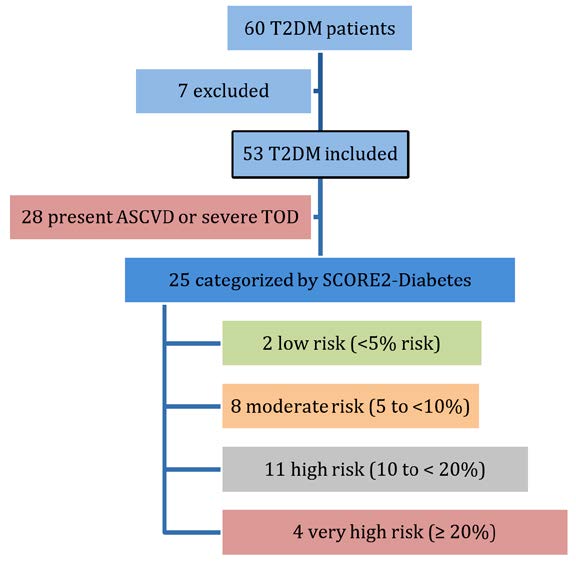
Results: A sample of 60 patients was considered, with 53 ultimately selected for inclusion. The median age was 68 years old (IQR 59; 75), with males constituting 58% of the sample and smokers 11%. Median glycated hemoglobin was 7% (IQR 6.5, 8.1). Utilizing the SCORE2-Diabetes for cardiovascular risk stratification, results showed 8% of patients at low risk, 32% at moderate risk, 44% at high risk, and 16% at very high risk. Notably, 40% of patients were classified as low or moderate risk, a significant finding given that previous guidelines typically categorized individuals with diabetes mellitus as high or very high risk. These downgraded patients were younger, with smaller disease duration and higher estimated glomerular
filtration rate (p <0.05).
Conclusion: Our findings reveal a substantial proportion of patients previously categorized as high or very high risk now falling into the low or moderate-risk categories. The simplicity in calculation emphasizes SCORE2-Diabetes potential to refine precision in managing cardiovascular risk for this high-risk population.
Downloads
References
1. Visseren FLJ, Mach F, Smulders YM, Carballo D, Koskinas KC, Bäck M, et al. 2021 ESC Guidelines on cardiovascular disease prevention in clinical practice: Developed by the Task Force for cardiovascular disease prevention in clinical practice with representatives of the European Society of Cardiology and 12 medical societies With the special contribution of the European Association of Preventive Cardiology (EAPC). Rev Esp Cardiol. 2022;75:429. doi: 10.1016/j.rec.2022.04.003.
2. Marx N, Federici M, Schütt K, Müller-Wieland D, Ajjan RA, Antunes MJ, et al. 2023 ESC Guidelines for the management of cardiovascular disease in patients with diabetes. Eur Heart J. 2023;44:4043-40. doi: 10.1093/eurheartj/ehad192.Erratum in: Eur Heart J. 2023;44:5060. doi: 10.1093/eurheartj/ehad774. Erratum in: Eur Heart J. 2024;45:518. doi: 10.1093/eurheartj/ehad857.
3. Damaskos C, Garmpis N, Kollia P, Mitsiopoulos G, Barlampa D, Drosos A, et al. Assessing Cardiovascular Risk in Patients with Diabetes: An Update. Curr Cardiol Rev. 2020;16:266-74. doi: 10.2174/1573403X15666191111123622.
4. Timmis A, Vardas P, Townsend N, Torbica A, Katus H, De Smedt D, et al. European Society of Cardiology: cardiovascular disease statistics 2021. Eur Heart J. 2022;43:716-99. doi: 10.1093/eurheartj/ehab892. Erratum in: Eur Heart J. 2022;43:799. doi: 10.1093/eurheartj/ehac064.
5. Nesto RW. Correlation between cardiovascular disease and diabetes mellitus: current concepts. Am J Med. 2004;116 Suppl 5A:11S-22S. doi:10.1016/j.amjmed.2003.10.016
6. Gyldenkerne C, Mortensen MB, Kahlert J, Thrane PG, Warnakula Olesen KK, Sørensen HT, et al. 10-Year Cardiovascular Risk in Patients With Newly Diagnosed Type 2 Diabetes Mellitus. J Am Coll Cardiol. 2023;82:1583-94. doi: 10.1016/j.jacc.2023.08.015.
7. Nathani M, Vogel B, Mehran R. Closing the gap: cardiovascular disease in women. Climacteric. 2024;27:16-21. doi:10.1080/13697137.2023.2281935
8. Luca SA, Bungau RM, Lazar S, Potre O, Timar B. To What Extent Does Cardiovascular Risk Classification of Patients with Type 2 Diabetes Differ between European Guidelines from 2023, 2021, and 2019? A Cross-Sectional Study. Medicina. 2024;60:334. doi:10.3390/medicina60020334
9. Polkinghorne KR. Estimated Glomerular Filtration Rate versus Albuminuria in the Assessment of Kidney Function: What’s More Important? Clin Biochem Rev. 2014;35:67-73.
Downloads
Published
How to Cite
Issue
Section
Categories
License
Copyright (c) 2025 Internal Medicine

This work is licensed under a Creative Commons Attribution-NonCommercial 4.0 International License.